
CORE_Certification_SEO_Article_EN
Key Takeaways
CORE is an independently auditable code of conduct for mineral extraction.
Co-developed by Solidaridad and Unilever, CORE covers six dimensions: governance & legal compliance, labour rights, occupational health, safety, environmental protection, and community relations. Compliance is verified through third-party on-site audits by accredited bodies such as Control Union — not self-declaration.
Global brands are making CORE certification a supplier prerequisite — driven by genuine compliance pressure.
ESG disclosure requirements, the EU Corporate Sustainability Due Diligence Directive, and investor ratings are systematically shifting supply chain compliance responsibility upstream to the buying side. Sourcing from a CORE-certified supplier is an active risk-management decision, not a formality.
QINGYIJIANG Sodium Sulphate Co., Ltd. (QYJSSA) is among the first Chinese anhydrous sodium sulphate suppliers to achieve CORE certification.
Certified in 2016 with an annual certified output of 500,000 MT, QINGYIJIANG? has supplied Unilever, P&G, Henkel, and other leading global brands, with logistics reaching 30+ countries and regions.
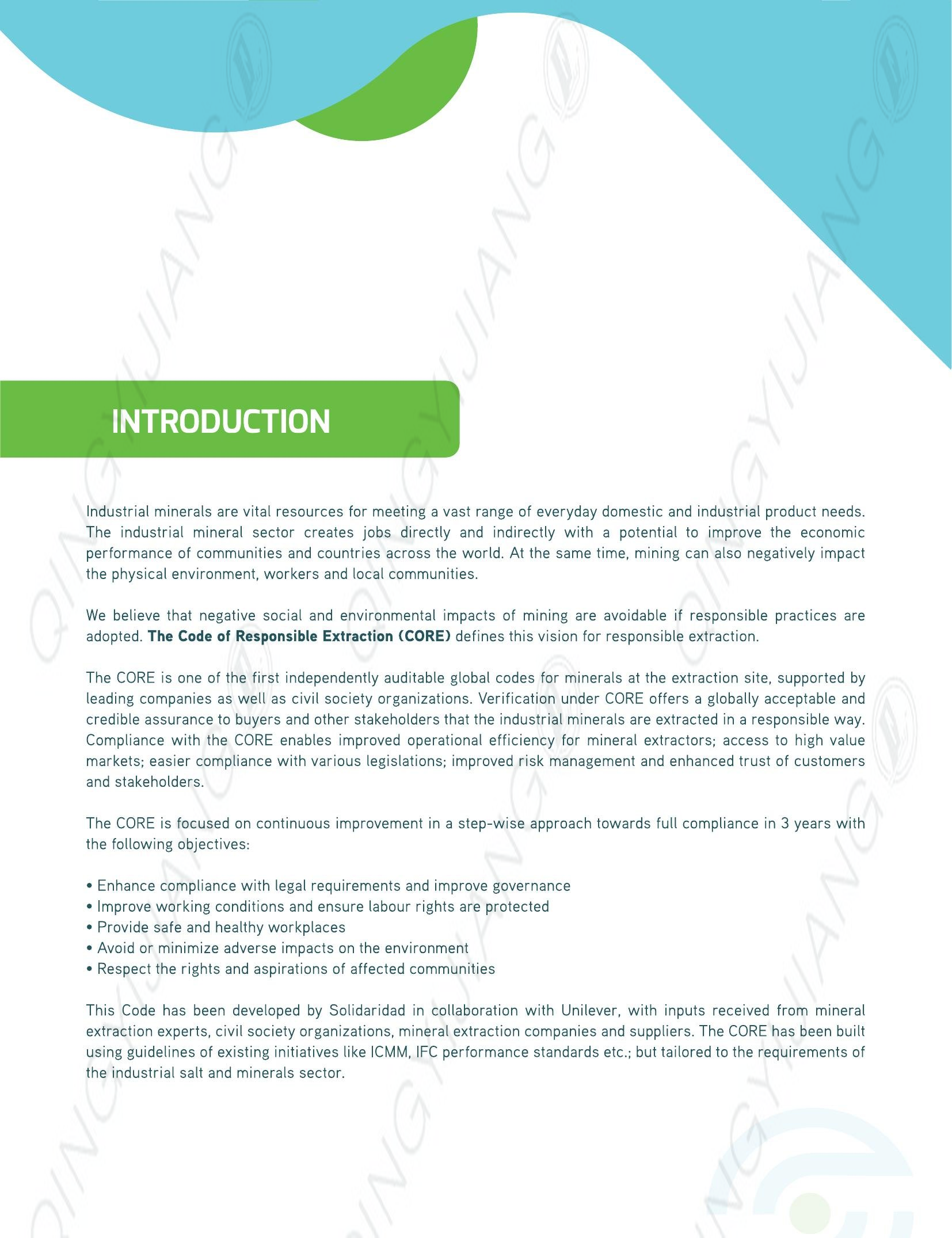
Figure 1:Code of Responsible Extraction (CORE) — official standard document co-developed by Solidaridad and Unilever
What Is CORE Certification? What Procurement Teams Need to Know Before Sourcing Industrial Minerals
If you source anhydrous sodium sulphate or other industrial minerals for a multinational brand or export-oriented manufacturer, chances are you have already encountered — or will soon encounter — the CORE certification requirement. This article explains what CORE covers, why leading global brands treat it as a supplier qualification threshold, and what else matters when conducting a full supplier evaluation for industrial mineral raw materials.
What Is CORE Certification?
CORE — the Code of Responsible Extraction — is one of the first independently auditable global codes of conduct for mineral extraction sites. Developed by Solidaridad in collaboration with Unilever, it was purpose-built to give industrial mineral buyers a credible, verifiable baseline for responsible sourcing — going well beyond regulatory minimums and supplier self-assessments.
CORE certification covers six dimensions:
? Governance & Legal Compliance: Lawful business operations, tax transparency, and anti-corruption mechanisms
? Labour Rights: Freedom of association, prohibition of forced labour and child labour
? Occupational Health: Workplace health protection and employee medical support systems
? Safety: Production safety standards, emergency response, and accident prevention
? Environmental Protection:Land rehabilitation, water resource management, and emissions control during extraction
? Community Relations: Stakeholder engagement mechanisms and benefit-sharing arrangements with local communities
Achieving CORE certification means a supplier’s extraction practices have been subject to independent on-site audits and document reviews conducted by an accredited international body — such as Control Union. Compliance is not self-reported; it is verifiable and publicly accountable.
Which Global Brands Require CORE Certification — and What Does It Mean for Your Sourcing?
Unilever was among the earliest adopters to integrate CORE certification into its raw material supplier evaluation framework. This trend reflects mounting external pressure on multinationals across ESG dimensions — from investor ratings and consumer scrutiny of brand values to hard regulatory requirements such as the EU Corporate Sustainability Due Diligence Directive (CSDDD).
For procurement teams, choosing a CORE-certified supplier is fundamentally a proactive risk management decision. In the event of a supply chain labour incident, environmental violation, or safety failure, buyers must demonstrate that adequate due diligence was conducted. CORE certification provides exactly that kind of documented, traceable evidence.
For trading companies and intermediary suppliers, holding upstream inventory sourced from CORE-certified manufacturers is an effective credential for demonstrating material provenance to brand clients — reducing friction in supplier qualification processes.
Beyond CORE: What Else Should You Evaluate When Sourcing Industrial Minerals?
CORE certification addresses how minerals are extracted. A complete supplier evaluation for anhydrous sodium sulphate should also cover the following:
? Product Quality Standards: Look beyond the headline purity figure. Assess the applicable standard (e.g. GB/T 6009), purity grade, and batch-to-batch consistency. For downstream applications in textiles, glass, and detergents, intra-batch purity variance directly affects yield rates — and is often a more critical procurement parameter than unit price.
? Supply Continuity: Evaluate annual production capacity, inventory management practices, and the supplier’s ability to respond to demand spikes. Scheduling flexibility and responsiveness are often better indicators of a supplier’s collaborative intent than nameplate capacity alone.
? Green Manufacturing Credentials: For procurement teams with ESG reporting obligations, a supplier’s energy efficiency technology and emissions data carry direct reference value. Carbon footprint per tonne of output is increasingly relevant in supplier scorecards.
? Logistics Coverage and Delivery Reliability: Assess warehouse network configuration, supported trade terms (FOB / CIF / DAP), and the markets the supplier has demonstrably served. These factors directly determine total landed cost and delivery reliability.
QINGYIJIANG Sodium Sulphate Co., Ltd.: A CORE-Certified Anhydrous Sodium Sulphate Supplier from China
Founded in 1997 and headquartered in Hongya, Meishan, Sichuan, QINGYIJIANG Sodium Sulphate Co., Ltd. (QYJSSA) is a vertically integrated manufacturer and exporter of anhydrous sodium sulphate. The company’s mine and production facilities are located in a natural thenardite-rich mineral zone on the southwestern edge of the Sichuan Basin.
Key credentials and capacity data:
? CORE Certification: First-batch certified in 2016, certificate issued by Control Union; annual certified output of 500,000 MT of anhydrous sodium sulphate
? Mineral reserves exceeding 25 billion MT, supporting over 400 years of sustainable extraction
? Annual production capacity of 1,000,000 MT; two MVR (Mechanical Vapour Recompression) energy-efficient evaporation lines in operation
? Near-zero CO? emissions in the production process — among the first in the domestic industry to achieve this
? Logistics: multi-modal coverage via road, rail, and waterway, leveraging the Yangtze River Golden Waterway, China-Europe Railway Express, and the New International Land-Sea Trade Corridor; warehouse nodes across Southeast Asia, South Asia, the Middle East, Europe, and the Americas; active business in 30+ countries and regions
Reference clients (partial list):
Unilever, Procter & Gamble (P&G), Henkel, UNIQLO, APRIL Group (ZAPP), and other leading global brands.
If you are evaluating anhydrous sodium sulphate suppliers or would like to request QINGYIJIANG?’s CORE certification documentation, product test reports, or a quotation, please contact us via our website.
Website: www.zsaoran.cn